Most fashion stores face the same frustrating pattern: traffic is growing, products are getting views, but sales don’t follow. Shoppers browse, compare, and then leave—often because they’re overwhelmed by too many choices and not enough guidance. In today’s competitive eCommerce landscape, simply listing products isn’t enough. Customers want inspiration, not just inventory. That’s where AI outfit recommendation comes in—transforming how fashion brands present products, guide decisions, and ultimately turn casual browsers into confident buyers.
Why Fashion Stores Struggle to Convert Visitors into Buyers?
Many fashion eCommerce stores attract steady traffic—but turning those visitors into paying customers is where things break down. The issue isn’t demand; it’s the shopping experience. When customers land on a product-heavy site without clear direction or inspiration, they hesitate, overthink, and often leave without buying.
Key issues:
- Too many choices → decision paralysis: Endless product listings make it harder for shoppers to decide, not easier.
- No styling guidance: Customers don’t always know how to combine items into a complete look.
- Low perceived value per item: A single product feels less compelling than a curated outfit.
- Poor product discovery: Relevant items are often buried, making it difficult for users to find what they actually want.
👉 Micro insight: Selling items ≠ selling outfits
What Is AI Outfit Recommendation (And Why It Works)
AI outfit recommendation is a technology that helps fashion stores suggest complete, styled looks to customers—based on data rather than guesswork. Instead of showing random products, it curates combinations that feel relevant and personalized.
Explain simply: AI analyzes:
- User behavior (clicks, views, time spent)
- Preferences (styles, colors, categories)
- Past purchases
Then it outputs: Complete outfit suggestions tailored to each shopper
Why it works:
- Reduces friction: Customers don’t have to figure out what matches—they’re shown ready-to-wear combinations.
- Mimics in-store stylist experience: It recreates the feeling of having a personal stylist guiding your choices.
- Speeds up decision-making: Fewer decisions → faster purchases → higher conversion rates.
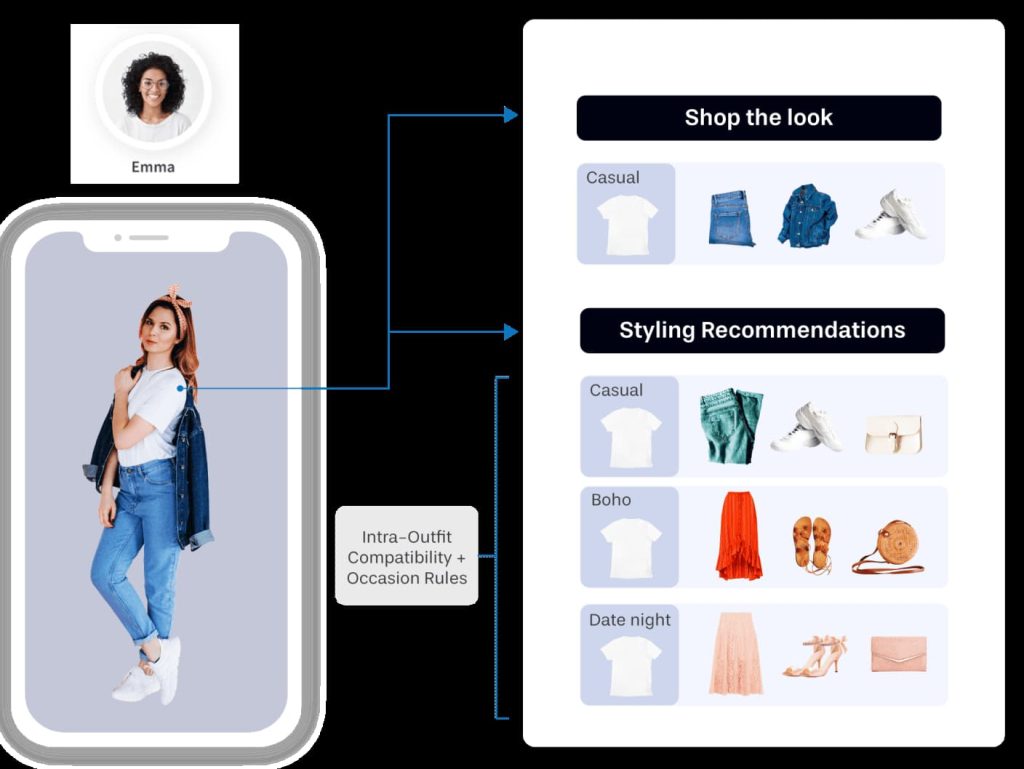
Real-World Examples of AI in Fashion eCommerce
To truly see the power of AI outfit recommendation, it’s not enough to understand the concept—you need to see how it plays out in real business situations. Below are practical, high-impact scenarios that show exactly what AI does, what you (the store owner) implement, and what results you can expect.
Scenario 1: Turning a Single Product Page into a Full Outfit Sale
Situation: A customer lands on a product page for a blazer. They like it—but they’re unsure how to style it or what to pair it with.
AI does:
- Analyzes the blazer’s attributes (color, fit, category)
- Pulls matching items (e.g., trousers, inner shirt, shoes) based on style compatibility and past user behavior
- Dynamically generates a “Complete the Look” section
Store owner does:
- Enables AI recommendation blocks on product pages
- Ensures product data is structured (categories, tags, styles)
- Optionally sets rules (e.g., prioritize high-margin items)
Result:
- The customer no longer sees just a blazer—they see a ready-to-wear outfit
- Decision-making becomes easier and faster
- Average Order Value (AOV) increases significantly because customers add multiple items instead of one
👉 This is where you shift from selling products → selling styled solutions
Scenario 2: Personalizing the Homepage for Each Visitor
Situation: A returning visitor comes back to your site. Previously, they browsed streetwear—hoodies, sneakers, oversized fits.
AI does:
- Tracks past behavior (clicks, categories viewed, time spent)
- Builds a real-time style profile for the user
- Reorganizes the homepage to show outfits aligned with that style
Store owner does:
- Integrates AI personalization into homepage or category pages
- Connects behavioral data (via cookies, user accounts, analytics tools)
- Defines key areas for personalization (hero banner, recommendations, featured looks)
Result:
- The visitor instantly sees relevant outfits, not generic products
- Feels like the store “understands” their taste
- Conversion rate increases because friction is reduced
👉 Instead of forcing users to search, AI brings the right products to them.
Scenario 3: AI Stylist Assistant That Guides the Customer
Situation: A customer is unsure what to wear for a specific occasion—like a date, office meeting, or vacation.
AI does:
- Asks simple questions:
- “What’s the occasion?”
- “What style do you prefer?”
- “Any color preferences?”
- Instantly generates outfit suggestions tailored to the answers
Store owner does:
- Implements an AI chatbot or styling widget
- Defines basic flows (occasion, budget, gender, style)
- Connects product catalog to the AI engine
Result:
- Shopping becomes interactive, not passive
- Customers feel guided—similar to having an in-store stylist
- Engagement time increases, and so does purchase intent
👉 This is especially powerful for stores with large catalogs where users feel lost
Scenario 4: Smart Bundling That Increases Perceived Value
Situation: Customers hesitate to buy because individual items feel expensive or incomplete.
AI does:
- Identifies items frequently bought together
- Creates dynamic bundles like: “Weekend Casual Look” or “Office Essentials Outfit”
- Suggests these bundles in real-time based on user context
Store owner does:
- Enables AI-driven bundling logic
- Adds pricing strategies (e.g., small discount for full outfit)
- Highlights bundles across product pages and cart
Result:
- Products feel more valuable when presented as a complete look
- Customers justify higher spending
- Revenue per customer increases, not just conversion rate
👉 You’re no longer selling a $50 shirt—you’re selling a $150 outfit experience
Scenario 5: Re-engaging Visitors Who Didn’t Buy
Situation: A user browses several items but leaves without purchasing.
AI does:
- Tracks abandoned sessions
- Generates personalized outfit recommendations based on what they viewed
- Uses email or retargeting ads to show those outfits later
Store owner does:
- Connects AI with email marketing or ad platforms
- Sets up automated flows (abandoned browse/cart campaigns)
- Uses dynamic content (AI-generated outfits in emails/ads)
Result:
- Customers are reminded with highly relevant suggestions, not generic ads
- Higher return rate and improved conversion from retargeting
- Better ROI on marketing spend.
AI outfit recommendation doesn’t just “suggest products.” It restructures the entire buying journey:
- From confusion → clarity
- From browsing → decision
- From single item → full outfit
And most importantly:👉 It turns your store from a product catalog into a personalized shopping experience that drives revenue.
How Fashion Stores Can Implement AI Outfit Recommendations
You don’t need a massive budget or a data science team to start using AI. In fact, most successful fashion stores begin with simple setups, then scale gradually. Here’s a practical, step-by-step approach tailored for small and medium businesses (SMBs).
Step 1: Get Your Product Data Ready (Foundation First)
Before using AI, your data needs to be “AI-friendly.”
What to do:
- Add clear categories (e.g., blazer, dress, sneakers)
- Tag products with attributes: style (casual, formal, streetwear) + color + season + occasion (work, party, travel)
Why it matters: AI relies on structured data to understand which items go well together. Poor data = poor recommendations.
Step 2: Start with Rule-Based “Outfit Bundling” (No AI Needed Yet)
Before jumping into full AI, start simple.
What to do
- Manually create “Complete the Look” sections
- Bundle items: Top + Bottom + Shoes
- Use Shopify apps or basic plugins to display bundles
Tools you can use:
- Shopify Bundles
- Frequently Bought Together apps
- WooCommerce Product Bundles
Result:
- Quick win with minimal cost
- Immediate increase in AOV
👉 This is your “Phase 0 AI” — simple but effective
Step 3: Add AI-Powered Recommendation Tools
Once you have basic structure, plug in AI tools to automate and scale.
Popular tools (SMB-friendly):
Vue.ai: Strong for visual AI + outfit recommendations
- Syte: Visual search + “shop the look” features
- Lily AI: Deep product tagging + personalization
- Recombee: Flexible AI engine (needs some setup)
- Shopify apps (AI-based): LimeSpot, Wiser, Rebuy
What to implement first:
- Product page recommendations
- “Complete the look” section
- Personalized product suggestions
Step 4: Personalize the Shopping Experience
Now move from general recommendations → personalized ones.
What to do:
- Track user behavior: clicks + viewed products + purchase history
- Show: personalized outfits on homepage + “recommended for you” sections
Tools:
- Built-in Shopify personalization apps
- Klaviyo (for behavior-based email flows)
Result:
- Higher relevance
- Increased conversion rates
Step 5: Use AI for Retargeting & Email Marketing
Don’t stop at your website—AI works great outside it too.
What to do:
- Send emails with: outfit suggestions based on browsing
- Run retargeting ads showing: full outfits (not single products)
Tools:
- Klaviyo
- Meta Ads (dynamic product ads)
- Google Performance Max
Result:
- Bring back lost customers
- Improve marketing ROI
Step 6: Measure, Test, and Optimize
AI is not “set and forget.”
Track these metrics:
- Conversion rate
- Average Order Value (AOV)
- Click-through rate on recommendations
- Revenue per visitor
What to test:
- Placement of recommendations
- Types of outfits (casual vs formal)
- Number of items in a bundle
👉 Small tweaks here can lead to big revenue gains.
Read more: Clothing Size Recommendation: How AI Reduces Returns in Online Clothing Stores
Conclusion
AI outfit recommendation is no longer a “nice-to-have”—it’s a practical way for fashion stores to turn browsing into buying. By guiding customers with complete looks instead of isolated products, even small and medium shops can increase conversions, boost order value, and create a more engaging shopping experience. Start simple, scale gradually, and you’ll turn AI into a real revenue driver—not just a tech feature.
